Wednesday, October 28, 2015

Vegan "Thai-talian" Volcano Rice Risotto with Crispy Carrots

This "Thaitalian" vegan risotto made with volcano rice is packed with minerals, antioxidants, nutrition, aroma and flavor. Absolutely delicious.


Ingredients:

  • 1 cup of organic volcano rice (http://www.lotusfoods.com/index.php/products/organic-products/organic-volcano-rice/)
  • 3/4 cup finely chopped leeks (white and pale green parts only)
  • ½ glass white dry wine
  • 3 cups  homemade Thai vegetable stock (see recipe below)
  • about ¼ cup of coconut milk
  • 1 orange carrot
  • 1 purple carrot
  • Salt as needed

Directions:


For the Thai vegetable stock:
  • 1 carrot, peeled
  • ½ celery stalk
  • 2 garlic cloves, peeled
  • 1 small potato, peeled
  • 1 shallot or other small onion, peeled
  • ½ zucchini (optional)
  • 1 inch piece of ginger, peeled
  • 1 stalk of lemongrass
  • 2-3 grape tomatoes, halved
  • a few sprigs of cilantro
  • 2-3 leaves of basil or Thai basil
  • 2-3 few kaffir lime leaves (if not available fresh, substitute with dry one)
  • about 6 cups of water
  • olive oil (a few tablespoons)
  • salt and pepper to taste


Rinse the vegetables, and cut into 1-inch chunks.
Roughly chop the ginger and the garlic.
Remove the hard outer layer of the lemongrass and cut the remaining soft inner core into 1 inch long pieces.
Heat oil in a medium stockpot. Add all the vegetables and herbs (except the tomatoes).
Cook over high heat for 5 to 10 minutes, stirring frequently.
Add salt, black pepper,  and water and bring to a boil. Lower heat, add the tomatoes, then simmer until stock is reduced by half (30-60  minutes). Strain. Discard vegetables. 

Pour the strained stock back in the stockpot and keep warm over low heat until ready to use.


Prepare the carrots:


Peel and shred the carrots, toss with olive oil and sprinkle with sea salt, then arrange in single layer on a baking sheet lined with parchment paper.
Bake at 375F for about 30 minutes turning a couple of times.
Once baked to desired texture, remove from oven and set aside.


Make the risotto:
Add enough olive oil to a medium saucepan to cover the bottom of the pan. Heat the oil, then add the leeks cook down on low to medium heat until translucent, stirring occasionally (about 5 minutes). Add the rice, and stir to coat the grains with the oil.  Turn up the heat, being careful not to burn the rice, add the wine, allow to evaporate while continuing to stir the rice, about  2 minutes. Add about 1/3 cup of  stock to the rice, stir, then cover, and simmer until the stock is absorbed, 5 to 10 minutes. Add more stock,  a few ladles at time, each time the mixture seems a bit dry, and stir. Cook, covered, checking occasionally to make sure the rice mixture has not dried out, for about 25-30 minutes. Add the coconut milk stir, cover, taste for salt, and add more if necessary, turn the heat off, and let sit for a few minutes until ready to serve. You want your rice to be somewhat soft, but not mushy, and the mixture creamy, not dry.

Sprinkle with the crispy carrots and serve.

Tuesday, March 3, 2015

My Indian Shrimp Curry


This is my version of an Indian prawn curry, which combines aromas, spiciness, sweetness and tanginess.  Please note that this recipe is sans coconut milk. For a creamier variation, some coconut milk may be added during simmering, and for a smoother texture, the gravy can be pureed after adding the tomatoes. 

Ingredients:

10 medium shrimp, shelled, rinsed and deveined (the tail may be left on, if one so desires)
1 tsp of black mustard seeds
About ½ inch piece of tamarind
1-2 small green chiles, chopped
3  peeled garlic cloves
about ½ inch piece of ginger
1 tsp of cumin seeds
1 chopped onion or a few chopped shallots
½ tsp of cumin powder
½ tsp of coriander powder and/or (optional) coriander seeds
1 tsp of garam masala
1 tsp of rasam masala (if available, if not, a pinch of red chile powder or a few broken pieces from a red dried chile)
½ tsp of turmeric powder
About 8 oz. of grape tomatoes, chopped
1/4 inch cube of jaggery
10-16 curry leaves
a few cilantro leaves, roughly chopped (optional)
Cooking oil (I use olive oil, but one can use coconut oil or other oil of choice)

Note: All of these ingredients can be found at any Indian grocery stores or online.

Directions:

Soak the tamarind in about 1/3 cup of warm water for about 30 minutes or more, then squeeze as much pulp as possible into the water, strain through a small strainer and set aside.

In a mortar and pestle, or a small food chopper, grind the green chiles, garlic cloves, ginger and cumin seeds to a paste. I recommend, that the first time preparing this dish, to only use one green chile,  and  later adjust the heat accordingly, with the rasam masala or red chile powder/pieces. Otherwise one runs the risk of this dish being packing too much of a spicy punch.  

Heat the oil in a pan, and add the mustard seeds (and optional coriander seeds). When they start to pop, add about half of the curry leaves, then a few seconds later, add the chopped onions or shallots, and cook until translucent, stirring occasionally (5-10 minutes).

Add the prepared paste, and fry for a couple of minutes, while stirring, and being mindful not to burn it.

Add the powders (cumin, masalas, turmeric, red chile), stirring constantly for about a minute.

Add the chopped tomatoes, and simmer down for about 5 minutes.

Add the strained tamarind pulp/juice, the the jaggery, plus  the remaining curry leaves and optional chopped cilantro leaves.

Add a few pinches of salt, then adjust to taste.

Increase the heat and simmer down for a few minutes until a thickened.

Add the shrimp and cook for a few minutes, being careful not to overcook them, as they will turn chewy.  

Serve with basmati rice, bulgur, quinoa, or a grain/legume of your choice.


You can also serve this shrimp curry with roasted baby eggplant, as shown below. Simply cut some rinsed baby eggplant lengthwise into quarters, and toss with olive oil, sliced onions (optional), a small pinch of garam masala and/or rasam masala powder, cumin seeds, salt and pepper. Roast in the oven at 375F for about 40 minutes.  Taste and add more salt if necessary, and serve along with the prawns.


Monday, March 2, 2015

Sautéed Onions and Roasted Beet Tart


Whenever I have extra onions in my pantry, this simple and delicious recipe makes a no-brainer tasty appetizer or snack. Typically, when I host a dinner party, I offer some variation of an onion tart or flatbread, which is always a big hit with guests.

You can make this tart with just onions and cheese, or add roasted vegetables of your choice (also see my earlier post "Free-form Butternut Squash and Sautéed Onion Tart").

This time I had extra beets, and thought, why not?

Ingredients:

1 medium red onion
1 medium yellow or sweet onion
Extra virgin olive oil (enough to coat the bottom of a medium sized pan, and to coat the beets)
1 red beet, cubed into 1/4 inch cubes
About 8 oz. of goat cheese or another cheese of choice (for example, sweet gorgonzola, blue cheese, fontina, fresh mozzarella, alone or in combination)- sliced into 1 inch pieces
A handful of micro-greens, or sweet pea shoots
Salt and pepper to taste
1 sheet of frozen puff pastry (I used Trader Joe’s).

Directions:

Preheat the oven to 375F.

Coat the cubed beets with olive oil and bake on a baking sheet lined with parchment paper, for about 15-20 minutes, turning once. Be careful not to burn. Sprinkle with salt.

In the meantime, prepare the onions. Cut off the top of each onion and place cut-side down on a cutting board. Cut the onion lengthwise (vertically) in half, and remove the peel and outer layer.
Place the flat half back on the cutting board, and again lengthwise, slice  each half into relatively thin slices (about ⅛ inch thick).

Heat the olive oil in a medium size frying pan, add the sliced onions, and saute’ until translucent, for about 15 minutes, covered about ⅔ of the cooking time, stirring occasionally. To prevent the onions from burning, you may add about 1/4 cup of water about halfway through, and allowing it to evaporate. Once cooked, add salt and pepper to taste.

Gently unfold the thawed pastry, and if you see any tears or holes, use your fingers—and a little water if necessary—to gently squeeze the pastry back together.  If the dough appears to stick together, put it back in the refrigerator to cool, before attempting to roll it out again.

Lay the unfolded pastry square on a floured surface, and rub some flour on a rolling pin, which you will use to roll out the square to the desired thinness (but not too thin).  Roll the dough out with gentle outward motions.   Run a ravioli wheel or a knife along each side to create more even lines. The left over pastry dough can be molded together and flattened again, and shapes can be carved out to top the tart during baking.  

Line a baking sheet with parchment paper and carefully lay the thinned pastry dough on it, and with a fork prick the surface of the dough (like you would a regular pie crust).

Bake for 5 minutes, then remove from the oven and spoon the sautéed onions (after draining off any of sautéing liquid) evenly over the lightly baked pastry. Top with the roasted beet cubes and cheese, and any pastry shapes made from the left-over pastry.

Bake at 350-375F until golden brown (about 20minutes).Slightly cool, sparsely add the micro-greens, slice and serve.

May be refrigerated for up to 3 days,  and reheated. 

For a vegan option, use vegan puff pastry and omit the cheese, or use a vegan cheese of your choice.


Monday, January 12, 2015

Three-Bean Multi-pepper Chili con Carne


For your next Super Bowl Party, or to soothe the Winter blues, here is my chili recipe, packed with nutrition and flavor,  that I wrote for Now It's Dark Magazine

http://nidmag.com/win-the-chili-cookoff


Monday, December 15, 2014

South-Indian Savoy Cabbage and Tuscan Kale Saute' with Cherries


After preparing my Tuscan soup, I had some left over cabbages, and so using them for a South Indian saute' was a no-brainer. The basic ingredients and techniques are the same as many South Indian dishes, including the Poriyal I had published a few weeks ago, with the usual players that I always have in my pantry: urad dahl, black mustard seeds, cumin seeds, asafoetidia, turmeric, curry leaves, and green chilies.

The added sweetness from the cherries in this dish contrast nicely with the bitterness of the cabbage. The asafoetidia, curry leaves and cumin seeds confer that extra layer of flavor that is distinctive of South Indian cooking.

Because I am Italian, I cannot get away from using olive oil, so while most Indian dishes use some other vegetable oils, I always go back to my roots, and use some good EVOO, which is healthier than many vegetable oils. But one use the cooking oil that one feels more comfortable with.

This dish is so addictive that bite after bite,  before you know it you will be staring at an empty bowl. But the good news is that you don't have to feel guilty about it, because cabbages are low-calorie nutrition powerhouses. 

Ingredients

  • 1/2 savoy cabbage, rinsed and shredded
  • about 4 stalks of black Italian cabbage (also referred to as Tuscan kale), stems removed, and leaves chopped horizontally
  • shallots, about 5, sliced relatively thinly
  • green chilies – ½ or 1, for those who desire more heat
  • curry leaves – about 6
  • olive oil – enough to coat the bottom of a pan
  • black mustard seeds – 1/2 teaspoon
  • urad dhal – 1 teaspoon
  • cumin seeds- 1 teaspoon
  • asafoetedia- a healthy pinch
  • turmeric powder- a small pinch
  • dried cherries-a handful
  • salt (and optional black pepper) to taste

for pictured instructions on how to slice/shred the cabbages, visit my previous post
http://kitchening-with-francesca.blogspot.com/2014/12/ribollita-tuscan-bean-and-cabbage-soup.html

Method

1. Cover the bottom of a pan with the oil, then heat the oil on low. Add the mustard seeds and urad dahl.
2. Continue to fry on low heat till the mustard seeds make a popping sound and the urad dahl turns golden, making sure it does not brown.
3. Add the cumin seeds.
4. Add the green chilies, curry leaves, asafoetida (and turmeric). Fry for 10 to 12 seconds.
5. Add the shallots, and sauté until translucent.
6. Add the shredded savoy and Tuscan cabbages and saute’ on medium heat while stirring occasionally, several minutes.
7. Turn up the heat, and  add about ¼ cup of water, allow some to evaporate, stir again and then cook, covered, until soft, scraping the bottom with a wooden spoon (but don’t allow the sautee’ to burn).
8.Taste for doneness, and if necessary, add more water and repeat step 7 above.
10..Before the cabbage is fully done, add the dried cherries and cook uncovered for a few more minutes.
11. Drizzle with a small amount of extra virgin olive oil
12. Add salt and pepper to taste.

13. Serve with rice or couscous, or enjoy as is.

Monday, December 8, 2014

Creative holiday cocktail party fare

If you are stuck on creative holiday party recipe ideas, you may be inspired by my delicious write-up for  Now It's Dark Magazine, in which I propose two creative delectable recipes.


Avocado Mousse Deviled Eggs with Tomato Confit


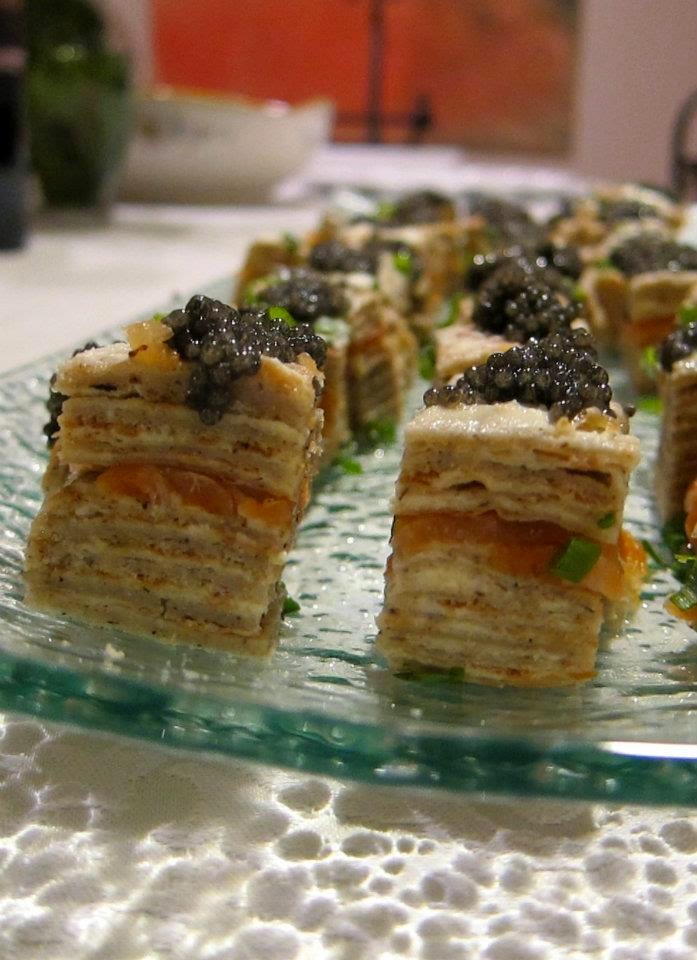
Mini Blini Salmon and Caviar Napoleons


Thursday, December 4, 2014

Ribollita- Tuscan Bean and Cabbage Soup


Being from Tuscany, "ribollita", which literally means "boiled again", was a frequent and welcome protagonist at our table. A satisfying, wholesome, flavorful and nutritious soup, completed with a drizzle of estate cold-pressed extra virgin olive oil, was without a doubt one of my favorite dishes growing up. In its simplicity lied its strength, and consequently its increasing popularity over the years, which is also in part attributable to many celebrity chefs and bloggers offering up variations of this Tuscan classic. My version, which is the one I grew up with, is most simple, where the stars are the beans and the cabbage. I have seen variations with carrots, zucchini or potatoes, which, in my opinion, transform this basic soup into almost a minestrone.  

Although some recipes call for addition of chicken stock, I strongly advise against it, as it completely alters the intended flavor. We are not making chicken soup here, we are making a soup of beans and cabbage, so chicken stock really does not belong. Rather, the flavor is enhanced the classic "battuto di odori", a combination of chopped onions, carrots, celery and fresh parsley, sauteed to perfection, and which serve as the base for many Italian recipes.

From a true Tuscan with love....

savoy and black cabbage

Ingredients:

1 carrot
1 onion
1/2 celery stalk
a few sprigs of parsley
1 15-oz can of diced or pureed tomatoes (or the equivalent in freshly chopped or pureed tomatoes)
1 15-oz can of cannellini beans (or the equivalent in cooked dry or fresh cannellini beans)
1/2 savoy cabbage, rinsed and thinly sliced
about 4 stalks of black Italian cabbage (also referred to as Tuscan kale), stems removed, and leaves chopped horizontally
about 2 cups of vegetable stock or water
extra virgin olive oil- enough to coat the bottom of a medium size pan, plus about 1 tablespoon to drizzle the soup at the end
salt and freshly ground pepper to taste
several slices of oven-dried or a few days old rustic bread or baguette

showing the black cabbage with the stems removed

showing the chopped cabbages
Method:

Finely chop the carrot, onion, celery and parsley  on a cutting board, or pulse  in a food processor until fine. This is what we refer to in Italian as “battuto di odori”.

In a medium size cooking pot, heat the olive oil, add the chopped “odori” and cook until softened (about 10 minutes), being careful not to burn them. Add the beans along with the liquid, and cook for another 10 minutes. Add the savoy and black cabbage, the stock, the tomatoes(or puree) and cook, semi covered, for about 1 hour, until reduced and everything is soft. With a ladle, remove about 1 cup of the soup (beans, cabbage and all), blend it in a blender until smooth, then pour back in the pot and cook down some more (about 10-20 minutes). Blending a portion of the soup confers a more velvety texture.

Add salt and freshly grated black pepper to taste.

Allow to cool and rest, preferably overnight. Before serving, bring to a boil (hence the name ribollita), and serve in a bowl over toasted bread. Drizzle with some good quality extra virgin olive oil.